

Years after Brexit, we're still scratching our heads, wondering whether data roaming is free in Europe for UK travellers. One minute, you're reading that it is. The next, you read about a business owner being charged £42k after his daughter spent hours on TikTok in Morocco on an uncapped contract. So what's the real story?
The answer isn't straightforward and involves EU rules, non-EU countries, tiny microstates you might never have heard of, and network-specific policies that change like the weather.
In this guide, we break down EU roaming charges in 2026, specifically the transition toward £2.00–£2.75 daily fees for European travel and the steeper £5.00–£7.50 rates for global destinations. We provide a concrete look at the new €1.10/GB (95p) wholesale price cap, how it affects your fair usage limits in countries like France and Spain, and why destinations like Turkey or Switzerland require a different strategy to avoid bill shock.
No, free roaming is no longer the standard among UK mobile networks. While some networks still offer inclusive roaming (subject to a roaming fair use policy), many of the largest ones now charge daily roaming fees, typically ranging from £2.00 to £2.50. To avoid roaming charges and bypass expensive daily data rates, UK travellers are now using a roam abroad pass from their home network provider, or buying affordable travel eSIMs ahead of their trips abroad.
What's covered in this guide:
Visit the Airalo store, choose your data package, and use the code UKIREBLOG15 to redeem. Terms and conditions apply.
EU Roaming Charges: What Changed After Brexit?

After Brexit, UK mobile networks were no longer legally required to offer free roaming across the EU, ending years of guaranteed surcharge-free travel. Before that, Roam Like at Home rules meant your phone worked exactly the same in Barcelona as it did in Birmingham.
What's the Roam Like at Home Regulation?
The Roam Like at Home regulation is an EU policy introduced in June 2017 that allows travellers to use their domestic mobile allowances within the EU and European Economic Area at no extra cost.
It effectively abolished roaming charges for millions of holidaymakers. Then Brexit happened. Because Roam Like at Home is an EU-wide legal requirement, British mobile networks are no longer legally obliged to provide it. That's why roaming policies now vary so massively from one network to the next.
Among the UK's Big Four networks (EE, Three, Vodafone, and O2), some still include certain European countries, while others charge daily fees. A few have even scrapped free roaming altogether. The rules differ depending on where you're travelling and which provider your contract is with.
While EU mandates no longer apply, Ofcom roaming rules introduced on October 1, 2024 mean that UK networks still have to give you clear information and alerts to help you avoid sky-high roaming bills.
Is Data Roaming Free in Europe for UK Travellers?
Data roaming is not automatically free in Europe for UK travellers.
Hidden Catches in Standard Roaming Policies
Even when your UK network includes European roaming, several restrictions can still drive up your costs:
- Fair-use caps that limit how much data you can use abroad at your domestic price.
- Extra charges apply once you exceed those limits. The data cap was set at €1.30 (£1.15) per GB of data in 2025 plus VAT. As of January 2026, the EU wholesale data cap has dropped to €1.10 (£0.95) per GB plus VAT. This will decrease further to €1 (90p) in 2027.
- Daily roaming fees that add up fast on longer trips. These are generally around £2 and £2.50 per day, depending on your network.
- Complete exclusions for certain countries (covered in the next section).
The reality of data roaming after Brexit is that there's no standard experience for travellers. So you really do have to check your specific mobile data plan before you head to the airport.
What Is the Roaming Fair Use Policy?
A roaming fair use policy is a set of restrictions your UK mobile network applies to limit how much data you can use abroad, even on plans marketed as free roaming. Consumer watchdogs like MoneySavingExpert warn that even when your network provider claims roaming is free, you might face reduced data allowances and slower speeds abroad.
What is a Roaming Fair Use Limit?
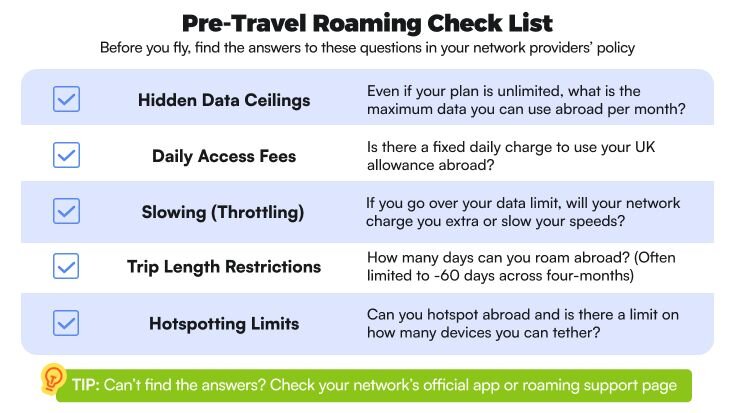
A roaming fair use limit is a strict data cap set by your mobile provider that restricts how much of your domestic data allowance you can use abroad before incurring extra fees.
Your UK mobile network has to pay local European networks for every gigabyte you use. To keep these costs in check, they set a ceiling. As of 2026, the EU wholesale price cap is €1.10 per GB (plus VAT). If you go over your fair use limit, your network can charge you up to this cap per GB until your next billing cycle starts.
Simply put, the small print in your roaming fair use policy may limit how much of your UK data allowance you can use abroad. Once you hit that ceiling, your network might throttle your speeds or start charging you for every extra megabyte.
Ever wonder why your data suddenly crawls at a snail's pace even though you still have bars? That's data throttling and could be a hidden side effect of your roaming FUP. Want to know how to keep your 5G speeds for the whole trip? Check out our guide on how to avoid data throttling on your travels.
Now, let's break down which countries EU roaming charges apply to and where you might be able to use data for free.
European Countries Where Roaming May Be Free for UK Travellers
Most UK mobile networks include the 27 EU member states and three EEA countries in their roaming packages at no extra daily charge. Terms vary by network, so always check your specific plan before you travel.
EU Member States Where Roaming is Usually Free
The following 27 EU member states are typically included in UK mobile networks' European roaming zones:
| Austria | Germany | Netherlands |
| Belgium | Greece | Poland |
| Bulgaria | Hungary | Portugal |
| Croatia | Ireland | Romania |
| Cyprus | Italy | Slovakia |
| Czech Republic | Latvia | Slovenia |
| Denmark | Lithuania | Spain |
| Estonia | Luxembourg | Sweden |
| Finland | Malta | France |
EEA Countries Often Included in UK Data Roaming Allowances
These three EEA countries are not EU members but are included in most UK networks' European roaming packages, though some budget contracts exclude them:
- Iceland
- Liechtenstein
- Norway
You'll find countries like Switzerland, Turkey, and Monaco on the 'not free' list below. While some premium UK plans include them as a bonus, most standard contracts treat them as 'rest of world.' If you're heading to these spots, don't rely on assumptions. Check your network's specific zone list before you fly to avoid surprise daily roaming fees.
Countries Where Roaming Is Not Free for UK Travellers
Several popular European countries are not included in standard UK roaming packages and will trigger extra charges. Many UK holidaymakers assume that being in Europe means free roaming, but countries outside the EU and EEA are almost always billed separately.
Non-EU European Countries Not Typically Covered by UK Packages
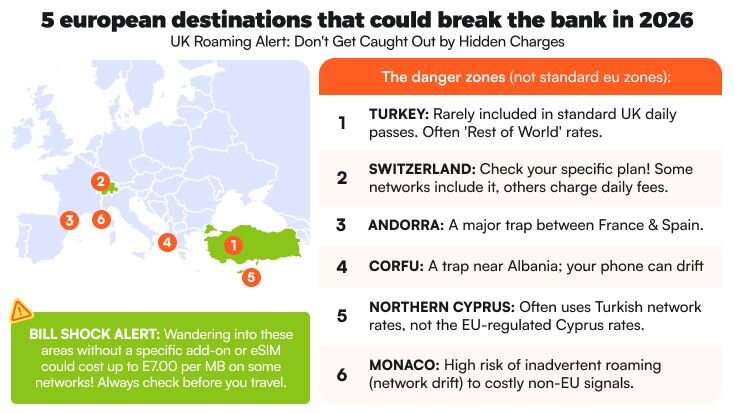
These non-EU European countries are typically excluded from UK networks' free roaming zones and will usually incur daily or per-MB charges.
- Switzerland and Turkey: Switzerland isn't in the EU, nor is Turkey, so roaming in these countries usually costs more than in EU countries. However, several networks do include Switzerland in their Europe Zone for free roaming.
- Montenegro, Albania, Bosnia and Herzegovina, Serbia, Kosovo, and North Macedonia: Non-EU/EEA countries. UK networks typically treat them as separate roaming destinations, with extra charges, rather than as part of an EU roaming zone.
- Ukraine and Moldova: Both were integrated into the EU's Roam Like at Home roaming area as of January 2026. However, UK networks are not bound by EU regulations and don't automatically have to offer free roaming in either country.
- Russia and Belarus: Classed as 'rest of world,' and not included in standard roaming packages.
Worth keeping an eye on: the EU is negotiating to bring several Western Balkan countries, including Montenegro and Albania, into the Roam Like at Home area by the end of 2026. Whether UK networks would follow remains to be seen.
Also known as network drift, inadvertent roaming is when your phone cheekily latches onto a signal from a nearby non-EU country where data charges are sky-high. It's a common trap in places like Corfu, where your phone can accidentally connect to an Albanian network, or at the Italian border with Switzerland. Under Ofcom roaming rules introduced in October 2024, your provider must promptly notify you when this happens. But it's still wise to manually lock your network settings to avoid surprises when you're travelling around a border region.
Which European Microstates Charge UK Travellers for Data Roaming?
European microstates like Andorra, Monaco, and San Marino are almost always excluded from UK networks' European roaming zones. Their small size and proximity to EU neighbours also make inadvertent roaming a common risk near their borders.
- Andorra: Squeezed between France and Spain and not part of the EU, Andorra is almost universally excluded from Europe roaming zones, and data rates here are typically charged at rest-of-world prices.
- Monaco: A non-EU country where roam like at home doesn't legally apply. While some premium UK plans and budget networks include it, most treat it as a paid destination. Beware of inadvertent roaming, which may see your phone latch onto a high-cost Monaco network while you're still technically on the French side of the border.
- San Marino and Vatican City: Geographically inside Italy but politically independent. While they often share Italian signals (which are usually covered), they aren't EU members. Some networks treat San Marino and Vatican City as separate, high-cost roaming zones.
- Liechtenstein: Although it's part of the EEA, rather than the EU, many networks include Liechtenstein in their European bundles. But it's a frequent hidden exclusion for certain budget contracts or specific daily-rate plans that only cover the EU 27.
Territories UK Holidaymakers Often Misunderstand
Several British crown dependencies and overseas territories have separate roaming classifications that don't follow standard UK or EU rules.
- Channel Islands (Jersey, Guernsey): These islands are crown dependencies that aren't technically part of the UK when it comes to roaming.
- Isle of Man: Another crown dependency with separate roaming rules.
- Faroe Islands: The Faroe Islands are part of Denmark, but are often excluded from roaming packages.
- Gibraltar: This being British Overseas Territory, Gibraltar is often included in many networks' data roaming packages, but coverage can vary.
How to Avoid Roaming Charges While Travelling Abroad
Avoiding roaming charges in Europe takes some planning. The options range from traditional workarounds like travel passes and Wi-Fi to newer solutions like eSIMs.
While this guide focuses on Europe, check out our guide on how to avoid roaming charges when you travel globally.
Traditional Ways to Avoid Roaming Fees
Before eSIMs became widely available, UK travellers had a handful of ways to manage roaming costs, though each comes with trade-offs:
- Buy a travel data pass/bolt-on from your UK network provider: Most major networks offer daily or weekly passes that let you use your UK allowance abroad. This is a convenient middle ground, but keep an eye on the fair use policy, as many of these unlimited passes actually cap your high-speed data.
- Turn off data roaming entirely: This stops automatic connections, so you won't be charged accidentally. But it means you'll have no data when you need to access apps and info.
- Switch to Wi-Fi calling: This works if you're always near Wi-Fi hotspots, but that's rarely the case when you're on the move.
- Use hotel or airport Wi-Fi: Although public Wi-Fi is often free and convenient, it's not secure. Travellers are usually cautioned not to enter sensitive information or use banking websites through it.
- Download offline resources before you leave: Even if you do have connectivity, downloading apps and media to use offline is a smart move to save data. However, if you're moving around in unfamiliar places and need real-time info, it isn't really a viable option on its own.
While these workarounds help, they all come with downsides. You're essentially disconnecting from the internet during your trip, which arguably defeats the purpose of having a smartphone. Plus, all it takes is one accidental app update over mobile data, and you could be back to surprise roaming bills. Thankfully, there's a much better solution that doesn't involve playing Wi-Fi hopscotch across Europe.
How to Avoid Surprise Roaming Fees with eSIMs
Travel eSIMs help you avoid surprise roaming fees by letting you buy a fixed amount of data upfront, with no daily charges or fair use caps. Here's how they compare to traditional roaming passes.
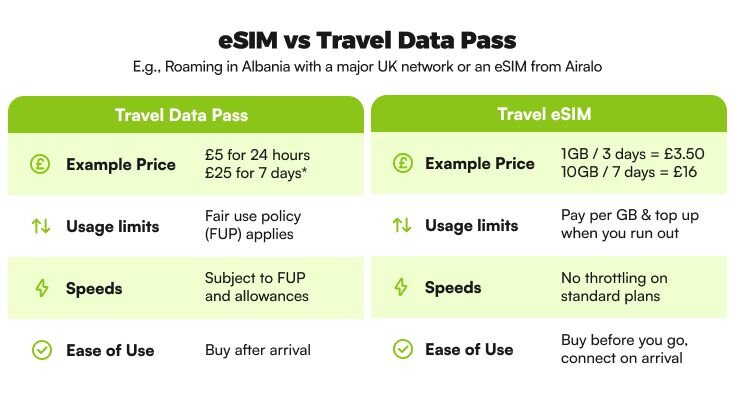
Top Benefits of Using Travel eSIMs
Travel eSIMs give UK travellers more control over their data costs than traditional roaming passes:
- You choose how much data you need and how long for: eSIMs are as flexible as your trip. You can choose between options such as 3GB for a weekend, 20GB for a month, or unlimited eSIM packages.
- Transparent pricing with no surprises: With an eSIM, you know exactly what you're paying upfront. So you won't have to keep interrupting your sunbathing to check your data limit or worrying about shock bills.
- No daily roaming fees: With eSIMs, you pay for data instead of facing daily charges through your home network provider.
- Coverage across multiple European countries: If you're on the move through several countries, regional eSIMs, such as eSIMs for Europe, will cover you across multiple destinations.
- Connect easily and quickly: Download your eSIM over your home Wi-Fi and activate it when you land for instant connectivity.
- Keep your UK number and your data separate: Using your eSIM for data and your UK phone number for calls and texts means you can stay online and in touch at the same time.
What UK Travellers Need to Know About Data Roaming After Brexit

Years after Brexit, the Roam Like at Home regulation era is no more, along with the guaranteed perks it once brought UK travellers. To avoid surprise roaming charges in 2026, we have to do a little more work than our EU neighbours to check our home network provider's terms and conditions and fair use policies.
Otherwise, those daily data roaming fees can quickly add up — even in our favourite holiday spots, like France and Spain.
Ultimately, knowing how to avoid roaming charges is about taking control before you even board the plane. Whether you go for a roam abroad pass or the convenience of eSIMs for travel, choosing transparent, fixed costs over unpredictable network rates means you can focus on that well-earned holiday without stressing about surprise bills.
Stay Connected Across Europe with Airalo
Whether you're hopping between Mediterranean islands, interrailing between European capitals, or staying put in a single destination, travel eSIMs from Airalo have got you covered. Choose from:
- Local eSIMs: Ideal if you're staying put in a single destination.
- Regional eSIMs: Covers multiple countries in a region, for example, a Europe eSIM that keeps you connected in 42 countries and networks.
- Global eSIMs: Seamless connectivity even if you're hopping between continents.
- Unlimited data options: Best for heavy data users, such as digital nomads.
Visit the Airalo store, choose your data package, and use the code UKIREBLOG15 to redeem. Terms and conditions apply.
store-faq.help-center-cta-aria-desc


